Showing posts with label Tempat Menarik Melaka. Show all posts

Portuguese Square

Portuguese Square Malacca is situated at the south of the district, Dalbuquerque road. Located near to St. JohnFort which is in the distant of 0.85km, the square is deemed to be easily accessible by the local and international tourists all these years. Cheng Ho Culture Museum and St. Paul's Hill (A'Famosa) is just few kilometers away from the square.The visible sight of Portuguese Square Malacca could be clearly seen from St. Paul's Hill (A'Famosa).


Portuguese Square Malacca also known as Mini Lisbon symbolizes the Portuguese community in Malacca. The square is the culmination of Portuguese culture in its splendor and colors where descendants of Malay and Portuguese intermarriages since the colonization of Portuguese in the state. Within the Portuguese settlement, the square is central to Portuguese culture and is the only one in its kind in Malaysia.


The square is renowned for the culture blends in the last 400 years. Renowned for its constant hosting unique and interesting stalls, restaurants and entertainment spots, the square has been popular since and one of the landmark that should not be missed out. The square is mostly visited on weekends when it turns on its festive mood and the Portuguese communities will put on their traditional costumes for performances. The square is accompanies by its ample choices of traditional Malacca Hotel that offer various package to suit your budget. Visitors will never find it bored when surrounded by plenty of local attractions in this historical town.


The Stadthuys is one of the local most renowned landmarks that believed to be the oldest building in the East. Nobody will leave the place without visiting Cheng Ho Culture Museum which is few kilometers away. The museum recorded the number of visitation and the journey of Ming Dynasty's Admiral Cheng Ho to Malacca. Several local attractions like St. John's Hill and St. Paul's Hill (A'Famosa) holds significant records of this historical town that would turn out to be a valuable journey.


Public Transport like taxi and bus available in the district could shorten the time of the journey might takes. 10 minutes to 15 minutes to reach the destination if by taxi and bus. One's could opt to local specialty trishaw that will take around 15 minutes to reach each location. 15 minutes to 20 minutes to selected destination by foot depend on the starting point.

Location Address :  Portuguese Square Jalan D'Albuquerque 75050 Melaka, Malaysia.

St. John's Fort

Part of Malacca's rich, diverse heritage from a different era.

Location Info
Address   :     Jalan Ujong Pasir, 75050 Melaka, Malaysia


Location 
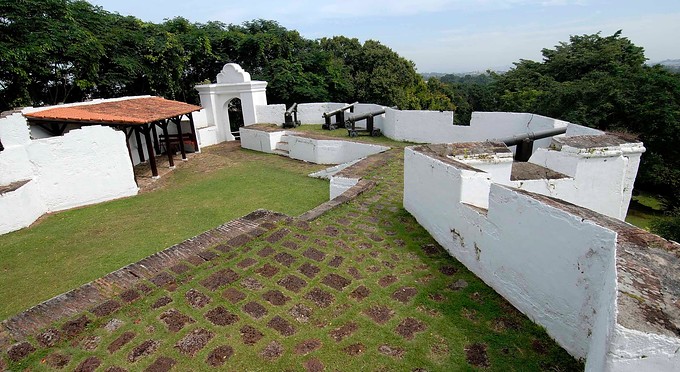
St. John's Hill is located at the south of Malacca, Bandar Hilir. Built at the top of the hill, it is deemed as located 3km away from the town. The nearest to St. John's Hill would be the Portuguese Square that situated at approximate 0.85km away. Followed by, St. Paul's Hill (A'Famosa) is 1.57km whilst Cheng Ho Culture Museum is 1.62km away from the St. John's Hill


Overview 
St. John's Fort was constructed by the Dutch in the 18th century and was once a private chapel dedicated to St. John the Baptist. The interesting features that should be paid attention, is the cannons in the fort that are faced inland instead to the sea. The view from the top of the hill where St. John's stands is particularly for the fantastic tropical sunset that consistently builds great valuable experiences.

To commemorate St. John's the Baptist, today's, the Catholics celebrate the feast on June 23 with thousands of candles lit in homes throughout the district, a memorable day everyone should experience. The morning visit to the St. John's Hill could witness the local resident does exercise near the fort that is deemed to be valuable insights to see a huge number of people in the early morning for morning exercise. A great start for anyone to their journey. Various popular landmarks; The Stadthuys, Baba Nyonya Heritage Museum and Melaka River Cruise could be seen from the top.

If you wanted more than that, Menara Taming Sari is the one you are looking for. The 7 minutes ride has ever fails anyone. Nearby destination, Jonker Walk, is the food and shopping paradise that offers different local cuisine and heritage. The popular district has so far never disappointed anyone with their furnished local heritage Malacca Hotel.


Transport 
Since St. John's Hill is located a little away from town. By taxi and foot would be the best options. The whole journey will take around 15 minutes to 18 minutes if by taxi. Approximate time taken is 20 minutes to 25 minutes if going foot.

Kampung Hulu Mosque

Kampung Hulu Mosque (Malay: Masjid Kampung Hulu) is an old mosque in Malacca Town, Malacca, Malaysia.

Built in 1728, Masjid Kampung Hulu is the oldest functioning mosque in Malaysia in its original location, at the corner of Jalan Masjid Kampung Hulu and Jalan Masjid in the old commercial district, now dominated by Chinese shop-houses. Commissioned by the Dutch during their colonial occupation, the mosque was a result of a new policy of religious pluralism. Their colonial predecessors, the Portuguese, had destroyed all signs of non-Christian establishments upon their occupation in 1511.

Kampung Hulu Mosque today, with a row of four-and-a-half story shop houses on the left hand side of the picture. The wall has been expanded, and the old door at the entrance is no longer in sight.

This included the tearing down of Malacca's first mosque, which had reputedly stood across from where the Stadhuys, the 1650s Dutch town hall that also served as the offices of the Dutch East India Company stands today. The Dutch assigned coordinating "Kapitans" to head the local populations in the reconstruction of their places of worship. Dato Samsuddin Bin Arom, or Dato Shamsudin, was commissioned to build the Masjid Kampung Hulu. It was later renovated by Wazir Al Sheikh Omar bin Hussain Al-Attas.

" This fascinating and ancient mosque has a multi-tiered "meru" roof, which owes its inspiration to Hindu temples, and a watch-tower minaret typical of early mosques in Sumatera and Java."

Partly due to the Dutch encouragement of cultural cross-pollination, the style of the mosque is reflective of a Javanese mosque. The regionally characteristic roof consists of three ascending layers of flared pyramidal roofs, separated by gaps to allow direct air and light into the building. These tiers are held aloft by four great columns in the center extending to outer columns for the lower, wider roofs. The centralized vertical hierarchy lends the structure to a square plan only disrupted by a small section of the porch area of the iwan, which juts from the front of the mosque. Masjid Kampung Hulu does not employ the Javanese tradition of using timber as the material for the walls, and instead engages stone and brick. The mosque is similarly unique in its elevation from the ground on a low stone perimeter wall.


Like other Malaccan mosques, Chinese ornamentation is revealed in the Masjid Kampung Hulu, including the crown like pinnacle surmounting the roofs and the curved eaves. It further incorporates materials imported from the Chinese Qing Empire, such as ceramic roof and floor tiles. Masjid Kampong Hulu further asserts its distinctiveness in its use of carved sea stones lining the inside of the dome.

Its stone minaret is also distinctly Malaccan in its adherence to a pagoda-form. The Tranquerah mosque was built in Malacca in the same year. 

From another postcard, the Kampung Hulu mosque with a white rooftop could be more recent than the one on the previous postcard. We can see that the roof of the mosque was covered with zinc, and there were vehicles on the road that looked much more modern than the bullock-carts.

You can also see the Melaka River not too far away from the front of the mosque. The building on the left behind has disappeared and changed, whereas some buildings on the right behind the mosque have been demolished.

View the mosque roof.
From the most recent picture, it can be seen that on the left hand side of the river are a row of four-and-a-half storey buildings built about 30 years ago.

Kampung Hulu Mosque's appearance is still pretty much the same today as two centuries ago, only that the surroundings have changed drastically over the years.

The 283-year-old mosque remains an important place for Muslims to visit and offer their prayers.

Address : Jalan Tokong  Melaka
Tel : 06-282 6526

The Baba Nyonya Heritage Museum

About Baba Nyonya Heritage Museum

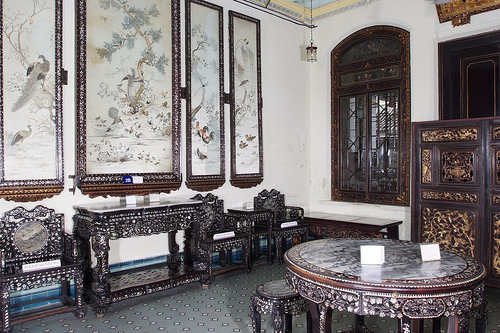
Baba-Nyonya, also known as Peranakan or Straits Chinese, is the descendants of noble Chinese who migrated to the British Straits Settlements of Singapore, Malacca and Penang, and adopted the Malay culture. This unique blend of cultures is born after the intermarriages between them and the local Malay.


This interesting and exceptional culture and its heirloom can now be seen at the Baba & Nyonya Heritage Museum. It is located at Jalan Tun Tan Cheng Lock, Melaka, and is run by the local Babas (males) and Nyonyas (females).


Established in 1896, the Baba-Nyonya Heritage Museum illustrates the way of living of the Peranakans, a unique blend of the east and the west.

Tips for Travelers

As you enter the museum, you get to see the historical artifacts that are unique to the cultural heritage treasured by the Baba and Nyonyas of Melaka. The museum, which is run privately, tells you everything you need to know about this community in Malaysia.  You can learn each and every bit of their history, culture and way of life within the four walls of this wonderfully designed building.


Among other things, one object that will capture your attention is an example of the Chinese tradition of foot-binding which was common among  girls of Baba Nyonya.  You can find the beautifully crafted and intricately designed miniature shoes presented next to the black and white photo exhibit of early Melaka.


How should visitors get to the Baba Nyonya Heritage Museum?

The museum is located on Heeren Street, which is parallel to Jonker Street, at the heart of the town of Malacca.

You can also get to the Baba Nyonya Heritage Museum by taxi if you are visiting Melaka for a short trip.  The taxi will cost you no more then RM 15.


If you have plenty of time then do consider taking a city bus.  You can get off near bus stop number 3, which is known as the “Baba & Nyonya Heritage” bus stop.

Approximate Touring Time

The approximate touring time for Baba Nyonya Heritage Museum is about 2 hours.

Nearby Attractions

There are plenty of attractions nearby the Baba Nyonya Heritage Museum.  A few of them are:
  • The Stadthuys
  • Christ Church Melaka
  • The Maritime Museum
  • Melaka River Cruise
  • Jonker Walk
There are also a couple of attractions within about 15 to 20 minutes of walking distance:
  • Menara Taming Sari (a revolving observation deck from a height of 80 meters)
  • St. Paul’s Hill (A’Famosa)
  • Dataran Pahlawan MegaMall
  • Mahkota Parade Shopping Mall
  • Dutch Fort
  • Istana Museum Melaka
Visiting Hours

The Baba Nyonya Heritage Museum is closed on Sundays and public holidays.  The visiting time is 10 am to 12:30 pm, and 2 pm to 4:30 pm.


Admission Charges

Admission charges for Baba Nyonya Heritage Museum are:
  • RM8.00 for Adults
  • RM4.00 for children (5-12 years old).
For more information, please contact:

The Baba-Nyonya Heritage Museum
48, 50 Jalan Tun Tan Cheng Lock
75200 Melaka,
Melaka, Malaysia.

Telephone : +606-283 1273


Melaka River Cruise

If you had a chance to visit Malacca, do not forget to ride the Malacca River Cruise.

From its role as a meeting point between the East and West in the 16th Century, the Melaka River has morphed into a tourism destination today. Both locals and foreigners come to soak in its history from the diverse architecture found along its banks. There are old churches, mosques, bridges, clan houses, warehouses, temples and villages that have withstood the test of time.


When I first saw the Melaka River 20 years ago, it was small and murky, with fishing boats crowding the river mouth. It was hard to imagine that this was the same river that attracted the Portuguese, the Dutch and the British to build a port and fortress here. Today, I see a modern waterfront with gardens, a fort, a fountain, performance stages, breezy walkways and a large windmill.

The Melaka River with its cruise is the biggest surprise. The muddy, murky water is now quite clear, with a tinge of emerald green. Clean embankments on both sides stretch for several kilometres. The river has also been widened and a mechanical device has been installed to control the depth of the water. The idea was to make the river completely pollution-free, so as to develop exquisite gardens on its banks, and pave the pedestrian pathways to perfection.


Passengers on the Melaka River cruise get a feel of the multi-cultural and historical fabric of the country. One can even see the Melaka tree, under which Parameswara was so inspired by the sight of a mouse deer kicking a dog that he named the place Melaka.

The 26 fibre-glass boats are named after historic figures such as Hang Tuah, Hang Jebat, Munshi Abdullah and Tun Perak. Passengers are also serenaded with traditional songs such as dondang sayang. 

         
Ticket Counter
There are two types of cruises. One offers recorded commentaries and the other has a tour guide on board. The approximate touring time for Melaka River Cruise is about 45 minutes (9 KM) from the Quayside Heritage Centre to Taman Rempah, Pangkalan Rama. The boats are available daily at every thirty minute interval between the following times: 9.30am to 5pm and 6pm to 12 midnight.

A must-see on the cruise is Kampung Morten, a living museum showcasing a village that's been around for hundreds of years. There are private museums here where one can get a deeper understanding of the local Malay culture including their costumes and crafts like embroidery work.


The houses are fine examples of Malay architecture, with sweeping staircases in the centre and a verandah where family members can sit in the evenings to enjoy the air.

You can also see the replica of a pirate ship, the Eye On Malaysia ferris wheel, the abandoned Cathay cinema as well as the old express bus terminal. There is also a replica of a royal windmill and a fort, complete with cannons around the walls.


The cruise boat passes under many bridges that had important functions in the old days. The first one, Tan Boon Seng Bridge, marks the strategic place captured by the Portuguese in 1511 in their bid to occupy Melaka. The other bridges are Chan Boon Cheng Bridge, Ghostbridge of Melaka, Old Market Bridge and Jalan Hang Tuah Bridge.

MELAKA RIVER CRUISE
Venue : The Melaka River jetty in front of the Quayside Heritage Centre.
Departs daily from 9am to 11.30pm
Ticket : Adult RM10, child below 12 : RM5
Group Tour : RM100 per boat
Can be arranged by calling Melaka River Cruise at 06-2814322 or cruise guide Bernard Kenneth Gooting at 012-9127210


Nearby Attractions

There are plenty of attractions near the Melaka River Cruise.  A few of them are:
  • The Stadthuys
  • Christ Church Melaka
  • The Maritime Museum
  • Jonker Walk
There are also couples of attractions within walking distance (about 15 ~ 20 minutes) :
  • Menara Taming Sari (a revolving observation deck from a height of 80 meters)
  • St Paul’s Hill (A Famosa)
  • Dataran Pahlawan MegaMall
  • Mahkota Parade Shopping Mall
  • Istana Museum Melaka

So, this ride was so exciting and fun. It is just not a ride, but along the ride, there were a history tells!

So, just enjoy your right. Relax your mind. And take a fresh air and enjoy view of Malacca River.


Cheng Ho's Cultural Museum

Had our simple buffet style breakfast at Cheng Ho Cafe, and follow by a nice tour at Cheng Ho (Zheng He) Cultural Museum (N2.195301 E102.248653) which is located at Lorong Hang Jebat of Melaka.

The Museum was restored from the Original Cheng Ho warehouse complex or Guang Chang where Cheng Ho Treasure Fleet visited Malacca (Melaka) at least 5 times in his the seven voyages to Western Ocean, interesting part was...all the buildings have the Ming architecture style.

Cheng Ho Cultural Museum at Malacca.

The entrance fee is RM20 for adult and RM10 for children. It's reasonable with the rich information Museum.

"Zheng He led seven expeditions to what the Chinese called "the Western Ocean" (Indian Ocean). He brought back to China many trophies and envoys from more than thirty kingdoms – including King Vira Alakeshwara of Ceylon, who came to China as a captive to apologize to the Emperor.

There are speculations that some of Zheng's ships may have traveled beyond the Cape of Good Hope. In particular, the Venetian monk and cartographer Fra Mauro describes in his 1459 Fra Mauro map the travels of a huge "junk from India" 2,000 miles into the Atlantic Ocean in 1420. What Fra Mauro meant by 'India' is not known and some scholars believe he meant an Arab ship. However, Professor Su Ming-Yang thinks "the ship is European, as it is fitted with a crow’s nest, or lookout post, at the masthead, and has sails fitted to the yards, unlike the batten sails of Chinese ships."  Source from Wiki.

The statue of Cheng Ho once you step into the Museum.

The History of Cheng Ho :-
"Zheng, born as Ma He (馬和 / 马和), was the second son of a Muslim family which also had four daughters, from Kunyang, present day Jinning, just south of Kunming near the southwest corner of Lake Dian in Yunnan.

In 1381, the year his father was killed, following the defeat of the Northern Yuan, a Ming army was dispatched to Yunnan to put down the army of the Mongol Yuan loyalist Basalawarmi during the Ming conquest of Yunnan. Ma He, then only eleven years old, was captured by the Ming Muslim troops of Lan Yu and Fu Youde and made a eunuch. He was sent to the court of one the emperor's son, Zhu Di the Prince of Yan, where he was called San Bao (三寶/三宝, or 三保) meaning Three Jewels." If you want to know more about the history, please visit Wiki.

The Cheng Ho Famous Ship name Bao Chuan (Treasure Fleet).

China had the excellent ship expertise during the Ming Dynasty. The Bao-Chuan (Treasure ship of Zheng He) was A large wooden vessel commanded by the Chinese Admiral Zheng He on seven voyages in the early 15th century.

"The purported dimensions of these ships at 137 m (450 ft) long and 55 m (180 ft wide) and a capacity of 2800t are at least twice as long as the largest European ships at the end of the sixteenth century and 40% longer and 65% wider than the largest wooden ships known to have been built at any time anywhere else. These dimensions are disputed on practical engineering grounds with some suggesting they were as short as 61–76 m (200–250 feet) or that they could only have been used on special occasions in the relative safety of the lower Yangtze river." If you like to know more about the Bao-Chuan (Treasure Ship).

Beside the History of Zheng He (Cheng Ho), the Museum also contain some little notes about the "The Legend of Puteri Gunung Ledang" and "Hang Tuah".


We saw many big and small wells along the way in the Museum...and I believe as long as there's well, that should be the territory of the warehouse complex.

One of the well in the Cheng Ho Cultural Museum.

Zheng He (Cheng Ho) and his Bao-Chuan - Treasure Fleet (which can accommodate about 500 peoples) started the first voyage on year 1405 and the last 7th voyage was on year 1433.

Cheng Ho's Treasure Fleet (partial) on his first voyage on year 1405.

The Bao-Chuan of Cheng Ho (Zheng He) which was not in scale.

The sailing route (sea map) by Cheng Ho Treasure Fleet.

Among all the display and the history corner of the Museum, I like the Miniature of Melaka very much! Photos below...


Miniatures of peoples at Malacca.


Miniatures of Malacca.


Once we finished most of the area in the Museum, we had been directed to a Nice garden with Full of antiques especially the unique building architecture! I called - 'The Time Machine'.


There was a tea garden area for visitors enjoying the tea and also admiring the Cheng Ho History from the Chinese Classical Puppet theater just opposite...

The Chinese Classic Puppet Show theater.

The Tea Garden in Cheng Ho Cultural Museum.

The History of Zheng He (Cheng Ho) in the puppet show.

We spent about an hour in the area and it was not enough time for me to explore every corner of the Museum...really appreciated to the Organizers of 'A Date with Bloggers' at Melaka who arranged the tour.

I will definitely visit back again for every detail of Cheng Ho History, because he was the guy who made a huge influence to Malaysia and also to Singapore...


The Stadthuys

At Malacca, the old Dutch colony of Malaysia's historic city, stands the grand and majestic Stadthuys.

This historical edifice dominates Malacca's renowned Dutch Square, or also known as the Red Square because of the crimson coloured old buildings there. Also located at the Square is Christ Church, the former Dutch Reformed Church of Malacca, where the pious Dutch people of the town had long before often congregated.


It is said that the Stadthuys is probably the oldest remaining Dutch colonial building left in Southeast Asia. However, the history of the Stadthuys remains somewhat of a mystery. Records of its construction have now either been lost in time or perhaps still buried in some forgotten archive, yet to be discovered. All that is known about the age of the building is that it was built shortly after Malacca was captured by the Dutch

Malacca came under Portuguese control by capturing the famous Malay trade emporium and ousting its sultan in 1511. Thereafter, the Iberians controlled the trade route in the Straits, much to the annoyance of the Dutch whose trade strength had grown tremendously in the region by the 17th century. Finally, an all-out attack for the capture of Malacca was ordered by Governor-general Antonio van Diemen and his council at Batavia.


The Dutch attack on Portuguese Malacca began in June 1640 with a large number of sails and troops. Fierce fighting erupted as the fort was bombarded by Dutch ships but were replied with the heavy guns of the Portuguese. Dutch and German VOC troops came ashore and pushed the defenders into the confines of their fortress.

Finally, both sides settled down to a long siege as they constantly harassed each other with repeated bombardments. The prolonged siege resulted in the spread of disease, both among the besiegers and the besieged. It was reported that more troops were killed by illness then by the hand of the enemy. Approximately 1,500 Hollanders perished, including 3 successive commanders and the whole of the secret council. However, Malacca finally fell to the hands of the Dutch on 14th January 1641.

When the dust of conflict settled and the Dutch had time to assess their newly acquired possession, they were alarmed to discover that little of the town had survived their relentless bombardments. "It was like the destruction of Jerusalem" they reported to their superiors in Amsterdam. So, the Dutch set about to rebuild Malacca from the ashes of its destruction.

The strong walls of the fort were repaired and defenses were further strengthened. Administrative buildings, commercial buildings, warehouses and private dwellings were built in the town and Asian traders were enticed to return to Malacca.


The first governor appointed to Malacca was Jan van Twist and the Dutch began building the Stadthuys to serve as the residency for the new governor as well as an administration centre and town hall. The Stadthuys was raised on the very same spot where the Portuguese governor’s house had been, which was too badly damaged to be of any use to the Dutch. Its construction was carried out by skilled Javanese and Chinese craftsmen.

The Stadthuys of Malacca is a reproduction of the former Stadhuis (town hall) of the Frisian town of Hoorn in the Netherlands. However, the former Stadhuis of Hoorn only existed from 1420 until 1796. Hoorn's former Stadhuis was replaced in 1796 by a building that is now known as het oude stadhuis (the old town hall), which is still found there. However, Hoorn's het oude stadhuis was in use until 1977 and at this moment the city hall of Hoorn is a modern building.

Therefore, anybody who wishes to see what the former Stadhuis of Hoorn looked like in the 15th to 18th centuries, only the Stadthuys of Malacca can give an excellent representation of the now extinct Frisian building.

In its heydays, the Stadthuys was situated within the walls of Malacca fort and located opposite the northern gateway into the fortified town, across the river. The fort itself encompassed a considerable area surrounding the hill of St. Paul’s, which accommodated offices and warehouses for the VOC and all the amenities needed by its colony. The fort walls no longer exist today thanks to the folly and vandalism of the British who maliciously ordered its destruction while safeguarding Dutch possessions in Asia from the French, during the Napoleonic wars.


MENARA TAMING SARI


Welcome to Menara Taming Sari Melaka

From a height of 80 metres, the ride offers you a spectacular and panoramic view of Melaka UNESCO World Heritage City and a far with a host of interesting sights such as St.Paul’s Hill, Independence Memorial Building,Samudra Museum and the ship, Flor De La Mar, Dataran Pahlawan, Pulau Selat Mosque, Pulau Besar and the Straits of Melaka. That apart you will also see the fast and rapid development taking place in the state.

How to get there
By Foot / Trishaw / Taxi

Menara Taming Sari lies in the center of the Lower Banda, Malacca and is easy to get to from wherever you MIGHT be staying.

Accommodation Overview
Melaka has a wide range of accommodation available, from basic backpacker's Hostels to 5-star hotels.

In addition to the opportunity to get a bird’s-eye view of Malacca, this attraction is also fitted with a tourist information centre and several commercial outlets consisting of a café, a restaurant and souvenir shops.


Tower Specifications

  1. Tower Name: Menara Taming Sari (360 degree viewing tower)
  2. Cost: RM24 million together with support Building (Melaka house)
  3. Height: 110 meter
  4. Passenger capacity: 66 passengers
  5. Made/Technology: Switzerland
  6. Ride Duration: 7 minutes


CONTACT INFO
Address : Jalan Merdeka Banda Hilir, 75000 Melaka, Malaysia.
Tel : 06-2881100 / 06-2813366
Fax : 06-2881551
GPS Coordinates : 2.1908, 102.2472
Operating hours : 10 am to 10 pm

Search This Blog