Showing posts with label Bandar Hilir Melaka. Show all posts

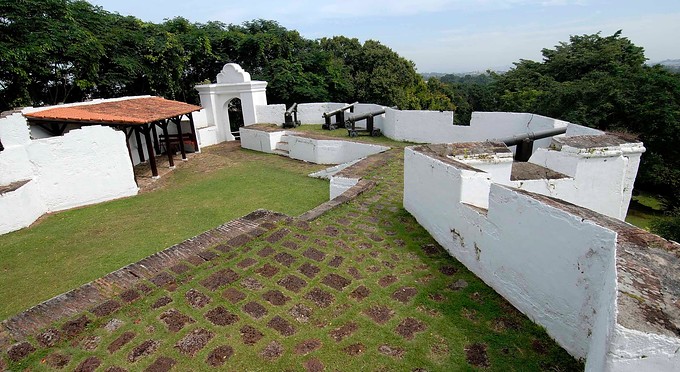
St. John's Fort

Part of Malacca's rich, diverse heritage from a different era.

Location Info
Address   :     Jalan Ujong Pasir, 75050 Melaka, Malaysia


Location 
St. John's Hill is located at the south of Malacca, Bandar Hilir. Built at the top of the hill, it is deemed as located 3km away from the town. The nearest to St. John's Hill would be the Portuguese Square that situated at approximate 0.85km away. Followed by, St. Paul's Hill (A'Famosa) is 1.57km whilst Cheng Ho Culture Museum is 1.62km away from the St. John's Hill

Overview 
St. John's Fort was constructed by the Dutch in the 18th century and was once a private chapel dedicated to St. John the Baptist. The interesting features that should be paid attention, is the cannons in the fort that are faced inland instead to the sea. The view from the top of the hill where St. John's stands is particularly for the fantastic tropical sunset that consistently builds great valuable experiences.

To commemorate St. John's the Baptist, today's, the Catholics celebrate the feast on June 23 with thousands of candles lit in homes throughout the district, a memorable day everyone should experience. The morning visit to the St. John's Hill could witness the local resident does exercise near the fort that is deemed to be valuable insights to see a huge number of people in the early morning for morning exercise. A great start for anyone to their journey. Various popular landmarks; The Stadthuys, Baba Nyonya Heritage Museum and Melaka River Cruise could be seen from the top.

If you wanted more than that, Menara Taming Sari is the one you are looking for. The 7 minutes ride has ever fails anyone. Nearby destination, Jonker Walk, is the food and shopping paradise that offers different local cuisine and heritage. The popular district has so far never disappointed anyone with their furnished local heritage Malacca Hotel.


Transport 
Since St. John's Hill is located a little away from town. By taxi and foot would be the best options. The whole journey will take around 15 minutes to 18 minutes if by taxi. Approximate time taken is 20 minutes to 25 minutes if going foot.

The Baba Nyonya Heritage Museum

About Baba Nyonya Heritage Museum

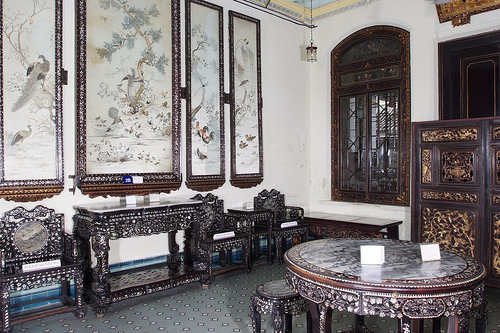
Baba-Nyonya, also known as Peranakan or Straits Chinese, is the descendants of noble Chinese who migrated to the British Straits Settlements of Singapore, Malacca and Penang, and adopted the Malay culture. This unique blend of cultures is born after the intermarriages between them and the local Malay.


This interesting and exceptional culture and its heirloom can now be seen at the Baba & Nyonya Heritage Museum. It is located at Jalan Tun Tan Cheng Lock, Melaka, and is run by the local Babas (males) and Nyonyas (females).


Established in 1896, the Baba-Nyonya Heritage Museum illustrates the way of living of the Peranakans, a unique blend of the east and the west.

Tips for Travelers

As you enter the museum, you get to see the historical artifacts that are unique to the cultural heritage treasured by the Baba and Nyonyas of Melaka. The museum, which is run privately, tells you everything you need to know about this community in Malaysia.  You can learn each and every bit of their history, culture and way of life within the four walls of this wonderfully designed building.


Among other things, one object that will capture your attention is an example of the Chinese tradition of foot-binding which was common among  girls of Baba Nyonya.  You can find the beautifully crafted and intricately designed miniature shoes presented next to the black and white photo exhibit of early Melaka.


How should visitors get to the Baba Nyonya Heritage Museum?

The museum is located on Heeren Street, which is parallel to Jonker Street, at the heart of the town of Malacca.

You can also get to the Baba Nyonya Heritage Museum by taxi if you are visiting Melaka for a short trip.  The taxi will cost you no more then RM 15.


If you have plenty of time then do consider taking a city bus.  You can get off near bus stop number 3, which is known as the “Baba & Nyonya Heritage” bus stop.

Approximate Touring Time

The approximate touring time for Baba Nyonya Heritage Museum is about 2 hours.

Nearby Attractions

There are plenty of attractions nearby the Baba Nyonya Heritage Museum.  A few of them are:
  • The Stadthuys
  • Christ Church Melaka
  • The Maritime Museum
  • Melaka River Cruise
  • Jonker Walk
There are also a couple of attractions within about 15 to 20 minutes of walking distance:
  • Menara Taming Sari (a revolving observation deck from a height of 80 meters)
  • St. Paul’s Hill (A’Famosa)
  • Dataran Pahlawan MegaMall
  • Mahkota Parade Shopping Mall
  • Dutch Fort
  • Istana Museum Melaka
Visiting Hours

The Baba Nyonya Heritage Museum is closed on Sundays and public holidays.  The visiting time is 10 am to 12:30 pm, and 2 pm to 4:30 pm.


Admission Charges

Admission charges for Baba Nyonya Heritage Museum are:
  • RM8.00 for Adults
  • RM4.00 for children (5-12 years old).
For more information, please contact:

The Baba-Nyonya Heritage Museum
48, 50 Jalan Tun Tan Cheng Lock
75200 Melaka,
Melaka, Malaysia.

Telephone : +606-283 1273


Cheng Ho's Cultural Museum

Had our simple buffet style breakfast at Cheng Ho Cafe, and follow by a nice tour at Cheng Ho (Zheng He) Cultural Museum (N2.195301 E102.248653) which is located at Lorong Hang Jebat of Melaka.

The Museum was restored from the Original Cheng Ho warehouse complex or Guang Chang where Cheng Ho Treasure Fleet visited Malacca (Melaka) at least 5 times in his the seven voyages to Western Ocean, interesting part was...all the buildings have the Ming architecture style.

Cheng Ho Cultural Museum at Malacca.

The entrance fee is RM20 for adult and RM10 for children. It's reasonable with the rich information Museum.

"Zheng He led seven expeditions to what the Chinese called "the Western Ocean" (Indian Ocean). He brought back to China many trophies and envoys from more than thirty kingdoms – including King Vira Alakeshwara of Ceylon, who came to China as a captive to apologize to the Emperor.

There are speculations that some of Zheng's ships may have traveled beyond the Cape of Good Hope. In particular, the Venetian monk and cartographer Fra Mauro describes in his 1459 Fra Mauro map the travels of a huge "junk from India" 2,000 miles into the Atlantic Ocean in 1420. What Fra Mauro meant by 'India' is not known and some scholars believe he meant an Arab ship. However, Professor Su Ming-Yang thinks "the ship is European, as it is fitted with a crow’s nest, or lookout post, at the masthead, and has sails fitted to the yards, unlike the batten sails of Chinese ships."  Source from Wiki.

The statue of Cheng Ho once you step into the Museum.

The History of Cheng Ho :-
"Zheng, born as Ma He (馬和 / 马和), was the second son of a Muslim family which also had four daughters, from Kunyang, present day Jinning, just south of Kunming near the southwest corner of Lake Dian in Yunnan.

In 1381, the year his father was killed, following the defeat of the Northern Yuan, a Ming army was dispatched to Yunnan to put down the army of the Mongol Yuan loyalist Basalawarmi during the Ming conquest of Yunnan. Ma He, then only eleven years old, was captured by the Ming Muslim troops of Lan Yu and Fu Youde and made a eunuch. He was sent to the court of one the emperor's son, Zhu Di the Prince of Yan, where he was called San Bao (三寶/三宝, or 三保) meaning Three Jewels." If you want to know more about the history, please visit Wiki.

The Cheng Ho Famous Ship name Bao Chuan (Treasure Fleet).

China had the excellent ship expertise during the Ming Dynasty. The Bao-Chuan (Treasure ship of Zheng He) was A large wooden vessel commanded by the Chinese Admiral Zheng He on seven voyages in the early 15th century.

"The purported dimensions of these ships at 137 m (450 ft) long and 55 m (180 ft wide) and a capacity of 2800t are at least twice as long as the largest European ships at the end of the sixteenth century and 40% longer and 65% wider than the largest wooden ships known to have been built at any time anywhere else. These dimensions are disputed on practical engineering grounds with some suggesting they were as short as 61–76 m (200–250 feet) or that they could only have been used on special occasions in the relative safety of the lower Yangtze river." If you like to know more about the Bao-Chuan (Treasure Ship).

Beside the History of Zheng He (Cheng Ho), the Museum also contain some little notes about the "The Legend of Puteri Gunung Ledang" and "Hang Tuah".


We saw many big and small wells along the way in the Museum...and I believe as long as there's well, that should be the territory of the warehouse complex.

One of the well in the Cheng Ho Cultural Museum.

Zheng He (Cheng Ho) and his Bao-Chuan - Treasure Fleet (which can accommodate about 500 peoples) started the first voyage on year 1405 and the last 7th voyage was on year 1433.

Cheng Ho's Treasure Fleet (partial) on his first voyage on year 1405.

The Bao-Chuan of Cheng Ho (Zheng He) which was not in scale.

The sailing route (sea map) by Cheng Ho Treasure Fleet.

Among all the display and the history corner of the Museum, I like the Miniature of Melaka very much! Photos below...


Miniatures of peoples at Malacca.


Miniatures of Malacca.


Once we finished most of the area in the Museum, we had been directed to a Nice garden with Full of antiques especially the unique building architecture! I called - 'The Time Machine'.


There was a tea garden area for visitors enjoying the tea and also admiring the Cheng Ho History from the Chinese Classical Puppet theater just opposite...

The Chinese Classic Puppet Show theater.

The Tea Garden in Cheng Ho Cultural Museum.

The History of Zheng He (Cheng Ho) in the puppet show.

We spent about an hour in the area and it was not enough time for me to explore every corner of the Museum...really appreciated to the Organizers of 'A Date with Bloggers' at Melaka who arranged the tour.

I will definitely visit back again for every detail of Cheng Ho History, because he was the guy who made a huge influence to Malaysia and also to Singapore...


A' Famosa

A' Famosa is a place that all visitors must visit while travel to Melaka.

A Famosa (Malay language: Kota A Famosa), or "The Famous" in Portuguese, is a fortress located in Malacca, Malaysia. It is among the oldest surviving European architectural remains in Asia. Only a tiny gate (called the Porta de Santiago) is all that is left of a once-mighty fortress.

Only remaining entrance only.

The name is often mispronounced as /eɪ/ Famosa, even among Malaysians (as though the Portuguese definite article "a" were the letter "A" in the English alphabet). A more accurate pronunciation would be /ɑ/ Famosa (approximating 'ah').

I am not sure if it was built without a roof or the roof collapsed.

The British in Penang were temporary caretakers of the then Dutch-controlled Malacca during the Napoleonic Wars. However, they were reluctant to hand Malacca back because they feared it might jeopardize the development of their new settlement in Penang. Hence they decided to destroy the regional influence of Malacca by diverting trade away from Malacca to Penang, the British planned to destroy the Malacca Fort and its city and move the 15,000 people to Penang. It was envisaged that Malacca would not rival Penang in terms of trade when the Kew treaty of 1975 expires which orders the returning of Malacca back to Dutch hands if the city was demolished and depopulated.

A Famosa history dates back to 1511 when the Portuguese
conquered Melaka. After establishing outposts like Macau and Goa,
the Portuguese fleet commanded by Alfonso de Albuquerque
attacked and defeated the armies of the Malacca Sultanate.

The Governor of Penang ordered Captain William Farquhar to have the respective fort demolished in 1807. However during this time, Stamford Raffles who hails from Penang arrived in Malacca for his sick leave. He managed to rescind the demolition and depopulation process with the consent of Lord Minto, the Governor General of India. Raffles managed to save the archway of the Malacca Fort which can be seen to this day. The destruction of the Malacca Fort cost 70,000 sterling pounds and involved several hundred workers.

HISTORY

In 1511 a Portuguese fleet arrived under the command of Alfonso de Albuquerque. His forces attacked and successfully defeated the armies of the Malacca Sultanate. Moving quickly to consolidate his gains, Albuquerque had the fortress built around a natural hill near the sea. Albuquerque believed that Melaka would become an important port linking Portugal to the spice trade from China. At this time other Portuguese were establishing outposts in such places as Macau, China and Goa, India in order to create a string of friendly ports for ships heading to China and returning home to Portugal.

As we entered the “gate” and this is the view from behind.
Once a gate to a fortress, it is now used by local artists
to sell their art work. As hot as the weather was when we were
visiting, these bricks of ancient times seemed to be able to shield
the heat so that people “staying” within these walls,
do not feel hot at all.

The fortress once consisted of long ramparts and four major towers. One was a four-story keep, while the others held an ammunition storage room, the residence of the captain, and an officers' quarters. Most of the village clustered in town houses inside the fortress walls. As Melaka's population expanded it outgrew the original fort and extensions were added around 1586. The fort changed hands in 1641 when the Dutch successfully drove the Portuguese out of Melaka. The Dutch renovated the gate in 1670, which explains the logo "ANNO 1670" inscribed on the gate's arch. Above the arch is a bas-relief logo of the Dutch East India Company.

From the Fortress and looking out to the
sea to watch out for incoming enemies.

The fortress changed hands again in the early 19th century when the Dutch handed it over to the British to prevent it from falling into the hands of Napoleon's expansionist France. The English were wary of maintaining the fortification and ordered its destruction in 1806. The fort was almost totally demolished but for the timely intervention of Sir Stamford Raffles, the founder of Singapore, who happened to visit Melaka in 1810. Because of his passion for history, this small gate was spared from destruction.


Search This Blog